M&A Expansion Complicated Data Collection for Management Accounting
As both a trading company and pharmaceutical manufacturer, Kowa Co., Ltd. operates a diverse range of businesses under the corporate theme of “Health and the Environment.” In its trading business, the company is focused on expanding operations in both consumer and industrial sectors with a view toward building a sustainable society. n its pharmaceutical business, Kowa develops and sells familiar over-the-counter medicines and has also entered the smart healthcare domain in recent years. In addition, the company runs hospitality businesses, including the management of local landmark hotels and wedding venues.
As part of its business expansion, Kowa has engaged in M&A activity and now oversees more than 40 domestic group companies. As the group expanded, the company recognized the need to go beyond simple “addition” of businesses and instead pursue cross-sector synergies. To support this strategic shift, Kowa turned its attention to enhancing management accounting.
The subsidiaries acquired through M&A vary widely in both size and business type. Each used a different accounting package, producing its own unique financial reports. To consolidate data for management accounting purposes, staff had to manually input figures from various accounting system outputs into a dedicated platform, then convert them to standardized account codes and indicators used in the group’s internal reports.
“Every time we executed an M&A or organizational restructuring, we had to reconfigure the system settings, which placed a significant burden on the Domestic Control Division.Additionally, many of the existing accounting systems used by our domestic group companies were not suitable for management accounting, making it difficult to access the key indicators and data needed for financial analysis,” explains the manager in charge of overseeing group company operations within the Domestic Control Division.
Introduced a dedicated system for management accounting instead of a full-scale company-wide replacement.
In light of these issues, the company initially considered a complete overhaul of its accounting systems across the entire group.
However, this approach was soon reconsidered due to the substantial costs involved, as well as the fact that each group company varied in business size—meaning a system replacement would have significant operational impact on each entity. As a result, the company began exploring alternative solutions. That was when GLASIAOUS caught their attention.
“One of our group companies happened to be considering GLASIAOUS as their accounting system, and that’s how we were introduced to it,” recalls the manager in charge. “After learning more, we realized that it offered a structure well-suited for monitoring group companies by consolidating data from existing accounting systems across multiple locations.”
Although several accounting systems were considered and compared, the decisive factors for choosing GLASIAOUS were its built-in grouping functionality—which allows for cross-company viewing of subsidiaries’ financial statements—its user-friendly interface, and its flexible report generation capabilities, all offered as standard features.
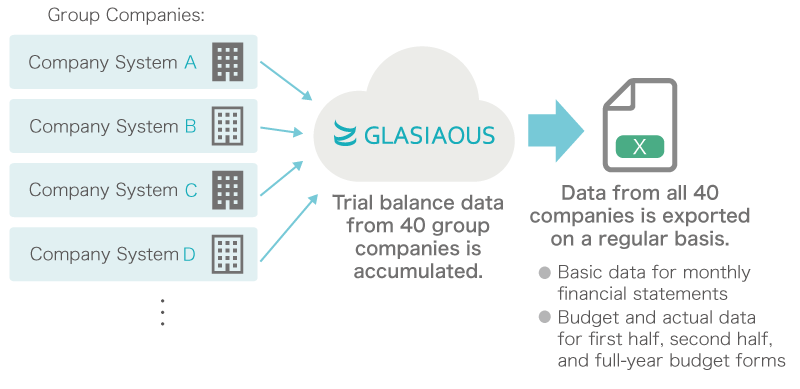
The envisioned system structure was as follows: each group company would continue using its existing financial accounting system, while GLASIAOUS would be introduced specifically for management accounting purposes. Under this workflow, each company uploads its monthly accounting data to GLASIAOUS, which then automatically generates standardized reports. These reports are regularly exported and stored in a designated location, where the Domestic Control Division and the Consolidated Accounting Team at headquarters can monitor the overall business performance of the group.
Preparations for implementation began in April 2022. Working closely with engineers from B-EN-G, the company proceeded with the deployment and successfully launched the system group-wide in July.
While there were some challenges—particularly in standardizing account codes across the various reports submitted by each group company—the implementation team recalls:
“We received not only technical support but also accurate advice on accounting procedures. That helped us resolve issues quickly and allowed us to complete the rollout on the shortest possible timeline.”
Generate a cash flow statement with a single click
As a result of the implementation, the workload related to generating monitoring reports for group companies at the Domestic Control Division has been reduced to less than half of what it was previously. In particular, changes to report settings were required 11 times in FY2021 alone.
“Our estimate is that even if the number of group companies increases through future M&A activity, the fact that we will no longer need to manually reconfigure report settings represents a significant reduction in effort,” says the executive in charge.
In terms of functionality, the implementation team praised the system, stating:
“With GLASIAOUS, importing data created in Excel can be done simply by using copy-and-paste commands, which has significantly reduced the time required. This is a rare but incredibly helpful feature for an accounting system.”
For management accounting reports, the company now not only uses standard financial statements such as the balance sheet (BS), profit and loss statement (PL), and manufacturing cost reports, but also takes greater advantage of GLASIAOUS’s reporting functions to generate financial analysis indicators. This has made it much easier to visualize the company’s financial position. Additionally, cash flow statements that previously had to be prepared manually can now be generated with a single click, expanding the variety of reports available for financial analysis.
Regarding the benefits of implementation for each group company, the section manager comments,
“The day-to-day operations remain largely unchanged. Moreover, some subsidiaries had previously expressed interest in accessing management analysis indicators, so we believe this brings significant advantages.”
Looking ahead, the company plans to leverage the management accounting data generated by GLASIAOUS in monthly divisional meetings and quarterly financial reporting meetings held with group companies.
With a view toward further advancing group-wide management accounting, the executive in charge adds,
“Beyond enhancing the use of monitoring features, we also hope that the financial data output by GLASIAOUS will be actively utilized by division heads and subsidiary management teams to support strategic decision-making and performance improvement.”